CHAI SEAS TRAVEL
exploring Jewish routes to your roots
"All journeys have secret destinations of which the traveler is unaware"___ Martin Buber


CRUISE SHIP SHORE EXCURSION CHAI LIGHTS
Seas the Day ashore!
GREEK CRUISE CHAI LIGHTS
Jewish Tours Walking tours in Greece
www.jewishtours.gr/ Salavador Levy
Tel: +30 210 9233919, Cell: +30 6932429741 Fax: +30 210 9227922
Rhodes Jewish Walking Tour A walk through history in the charming old town of Rhodes...to the Kahal Shalom Synagogue which is a Sephardic synagogue in La Juderia, the Jewish quarter of the old city of Rhodes on the Greek island of Rhodes. It is the oldest synagogue in Greece today. http://www.jewishrhodes.org
Thessaloniki (Salonica) Jewish Walking Tour A walk in the core of the city that once was the biggest Sephardic Jewish community in Europe!
Chania - Crete Jewish Walking Tour A walk through history in the charming multicultural old city of Chania.
Etz Hayyim Synagogue Until 1999 Etz Hayyim was a house of prayer that remained the sole Jewish monument on Crete after the destruction of Crete's Jewish community in 1944. Essentially it stood as a monument to the success of the Nazis in obliterating 2,300 years of Jewish life on Crete. Between 1996 and the year of its rededication in 1999, the structure was painstakingly restored. The philosophy that directed this work is summed up in the Hebrew Am Israel Hayy: 'The people of Israel live'. Today it stands as a vibrant statement of Jewish life, vitality and values, whereas until recently it was still mentioned on the World Monument Fund's list of most endangered sites.
http://www.etz-hayyim-hania.org/
Mykonos Delos
Romaniote 2d century BCE Delos synagogue and mikveh by the sea across from stadium on Left path beside museum.
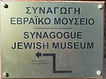
Athens Jewish Walking Tour Starting our tour from Syntagma square, next to the parliament building and its famous guards, we head for the Jewish museum. www.Jewishmuseum.gr

CARIBBEAN CRUISE CHAI LIGHTS
St Thomas Synagogue
If you're visiting St. Thomas, we hope you'll come to see our beautiful, historic Synagogue. Our beautiful sand floor synagogue is an architectural and historical gem in the middle of the Caribbean. Visitors of all faiths experience wonder and awe standing within its simple and stately interior. It is a must-see for all who visit St. Thomas.
We welcome you to our website and invite you to browse through its different parts. We also hope to welcome you in person to our Synagogue, which has been declared a National Historic Landmark.
You can find us on "Synagogue Hill" in downtown Charlotte Amalie, just a few short blocks up from the Waterfront and Main Street. Just take Raadet's Gade from Main Street (H. Stern is on that corner) up to the top of the hill, turn left and the Synagogue is the second building on the right.
Hebrew Congregation of St. Thomas
2116 Crystal Gade, St. Thomas, VI 00802 | Tel: 340-774-4312 | info@synagogue.vi
Mailing Address: PO Box 266, St. Thomas, VI 00804
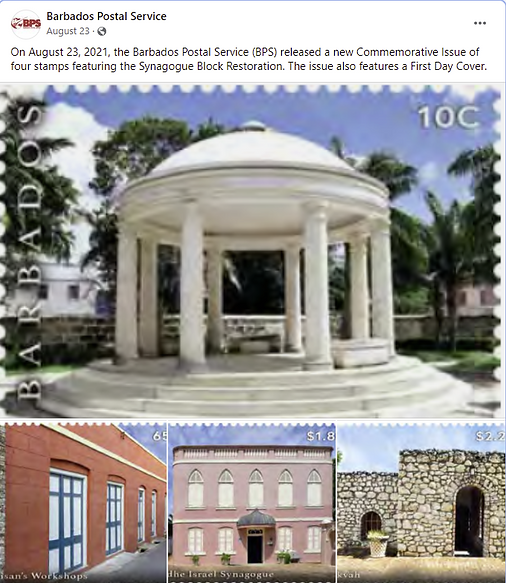
Bridgetown Jewish Synagogue
One of the Barbados.org's "Seven Wonders Of Barbados!"
There is currently one synagogue situated in Bridgetown. Built in the 17th century (1654) it was destroyed by hurricane in 1831, was rebuilt, fell into disrepair and was sold in 1929.
In 1983, it was bought back by the Jewish community and was restored to its present state with its beautiful Gothic arches, and is now a Barbados National Trust protected building and an active synagogue. Located next to the synagogue which has services Friday nights at 7:30 pm in the winter is the Nidhe Israel Museum with a 17th century working mikveh.
About 300 Jewish people of Recife, Brazil, persecuted by the Dutch, settled in Barbados in the 1660's. Skilled in the sugar industry, they quickly introduced the crop and passed on their skills in cultivation and production to the Barbados land owners.
With their help Barbados went on to become one of the world's major sugar producers.
The synagogue is located within the World Heritage Site - Historic Bridgetown and Its Garrison, just NW of the Parliament buildings on Prince William Henry Street and Synagogue Lane, Bridgetown, St. Michael, Barbados
https://synagoguehistoricdistrict.com/
Nevis Jewish Cemetery
The Jewish Cemetery in Charlestown off of Government Road is a tangible reminder of a once vibrant community that existed on the island of Nevis. The cemetery contains gravestones that are engraved in English, Hebrew and Portuguese, dating from 1679 to 1768. Once constituting 25% of the island's population, the Sephardic Jews of Nevis brought to the island the secret of how to crystallize sugar, a technique that had been discovered and protected by the Portuguese and the Spanish. Expelled from Brazil during the 17th century, their arrival in Nevis helped to make the island the 'Queen of the Caribbees,' a title that referred primarily to its remarkable sugar production. A stone-walled path, known as the 'Jews Walk,' leads from the cemetery to the supposed site of the community's synagogue or Yeshiva (where Alexander Hamilton is said to have studied!) which is believed to have been built in 1684.



SOUTH EAST ASIAN CHAILIGHTS
Jewish Singapore
Visit the two Baghdadi synagogues—Maghein Aboth (the oldest in SE Asia) on Waterloo Street, built in 1873, and Chesed El, on Oxley Rise, built in 1900, each of which has a large "walk-in" ark containing approximately two dozen Torah scrolls. Many descendants of Iraqi Jews here believe that commissioning a new Torah scroll is the most significant way to honor the memory of a deceased relative. And try to attend services at the Progressive congregation, United Hebrew Congregation of Singapore, where you'll be warmly welcomed. They're only held once a month on Friday nights, so check the synagogue website for the schedule.
Maghain Aboth Synagogue
24-26 Waterloo Street Singapore 187950
Tel: (65) 6337 2189
Email: mordehai@singnet.com.sg
Chesed-El Synagogue
2 Oxley Rise Singapore 238693
The Jews of Malaysia
https://www.youtube.com/watch?v=u-GXZbeyiaM in Yiddish!
The Jewish Cemetery, Penang
Neighborhood: Georgetown
Tel: +60 4 261 6663
(Penang Tourist Centre)
Address: Jalan Zainal Abidin
Penang MY, 10400
It used to be called Jalan Yahudi but it has been renamed Jalan Zainal Abidin, after the prolific Malay writer who is more popularly known as Za’aba.
By renaming the road, the Jewish legacy in Penang, and for that matter, in Malaysia, has been erased.
But the country’s only Jewish cemetery which was set up in 1805, is still in existence there.
It is well-maintained but most of the time, the gates are locked, perhaps mindful that it could be the target of anti-Semitic elements.
Located between Burmah Road and Macalister Road, the small cemetery escapes the attention of Penangites who use this link road, as it is tucked behind high walls.
According to a report titled A Penang Kaddish: The Jewish Cemetery in Georgetown — A case study of the Jewish Diaspora in Penang (1830s-1970s), the oldest Jewish tombstone in the cemetery is dated July 9, 1835.
Jewish Thailand
Chabad of Phuket
52/32 Ratch U-thit Song Roy Pee Rd. (opposite Patong Post Office)
Second row of town houses Patong, Katu District, Phuket 83150 Thailand
Telephone (6676) 342 476/7 Mobile Phone (6689) 892 2353
For more information phuket@jewishthailand.com
Jewish Myanmar (Burma)
Musmeah Yeshua synagogue 85 26th St, Pabedan
In the center of downtown Yangon stood Musmeah Yeshua, the grand synagogue with its soaring ceiling and graceful columns. Musmeah Yeshua, one of 188 sites on the list of Yangon Heritage Buildings, was constructed in the 1890s. The Jewish cemetery, with more than 600 gravestones, and the synagogue with its 126 silver sifrei Torah (Torah scrolls) and Jewish school for over 200 students, proclaimed Jewish affluence and comfort in this lush land.

EUROPEAN SYNAGOGUES MAP
Interactive map lets you discover Europe’s synagogues
Europe has 3,318 synagogues, according to a new British organization that unveiled what it said was the first-ever pan-continental study of Jewish houses of worship.
The Foundation for Jewish Heritage, which was registered in the United Kingdom in 2015 and aims to help preserve and restore endangered European synagogues, commissioned the Center for Jewish Art at The Hebrew University of Jerusalem to tally and document Europe’s synagogues.
The foundation’s launched last week in London, said the foundation’s chief executive, Michael Mail.
The results of the study, which took a year-and-a-half to complete, are on display on an interactive map accessible on the foundation’s website.
The map’s database includes a detailed classification for each registered synagogue, including such categories as its current condition, ranging from bad to excellent, its significance as a monument and its current status: used, disused or converted to serve as any one of a dozen purposes, including police station, mosque, garage and funeral parlor.
One synagogue mapped by the foundation in Poznan, Poland, is today a swimming pool. Another in Cracow, Poland, is a bar, Mail said.
Beyond providing researchers a continental overview that Mail said did not exist prior to the study, it also can serve as a reference point for philanthropists, added Mail, whose foundation identified some 160 synagogues in imminent risk of being ruined beyond the point of restoration.
“It allows for restoration efforts to become strategic,” Mail said. “Donors can see where they are most needed.”
Before WW II, Europe had some 17,000 synagogues, Mail said. Less than a quarter of the synagogues mapped by the Foundation for Jewish Heritage are now being used as such.


AMAZON ADVENURE: MENAUS, BRAZIL
MANAUS JOURNAL; IN THE AMAZON, AMAZING DOINGS AT RABBI'S TOMB
By MARLISE SIMONS, Special to the New York Times
Published: June 12, 1987
Even on a day more sultry than usual, some visitors filed past the rabbi's grave at the Manaus general cemetery, crossed themselves and added more mementos to the candles, pebbles, beads and coins covering his tomb. MANAUS, Brazil— Rabbi Salom Moyal of Jerusalem never intended to stay along the Amazon and perform miracles, but that is what people in this jungle city insist he has been doing for many years.
''He is a saint,'' said Maria Gomez, dowager of the cemetery workers, who has weeded and swept gravesites near that of the rabbi for many of her 79 years. ''He does miracles for people who come to him with faith.'' To dismiss any doubts, she pointed to the marble plaques along the tomb, all of them engraved with messages of gratitude.
The rabbi's unusual status as a miracle worker amid the Roman Catholic crosses is not a matter of concern for the 700 or so Jewish inhabitants of Manaus. They seemed to take in stride that in the heart of the great Amazonian rain forest, the magical and the miraculous soar easily while orthodoxy and convention have a way of getting blurred.
''It is a bit strange but no one really minds,'' said Inacio Obadia, who teaches and officiates at the local synagogue. ''It is a question of popular belief, nothing institutional.'' Among Early Settlers
If anything, the ''shrine'' of Rabbi Moyal, who died here in 1910, is seen as a curious reminder from an era when many Jews were among the early foreign settlers of the villages and towns that sprang up along the banks of the Amazon. Most had left the poor ghettos of Tangier and Tetuan in Morocco, steamed up Brazil's equatorial grid of rivers and helped establish a trade route reaching deep into the hinterland.
Their descendants here, in true immigrant tradition, still like to talk of that time - the mid-19th century -when the Amazon basin provided the world with rubber, cacao and hardwood and Jewish families ran prosperous trading companies near the Amazon estuary at Belem. These families hired the new immigrants for their warehouses and steamers and sent them out to create a chain of new posts far upstream.
''Soon every little town had a Jewish representative of the Belem houses,'' Mr. Obadia said. ''He would set up a general store.''
The boats from Belem took the goods to the storekeepers upriver and on the way back they picked up their bartered products like rubber, nuts and skins. Drawn by Rubber Boom
As the story is told here, Rabbi Moyal traveled up the Amazon during the great rubber boom to visit these settlers and to collect contributions for his theological school at home, in Jerusalem. But he fell victim to disease and died.
Since then, family members have at times tried to take the rabbi's remains back to Jerusalem, said Samuel Benchimol, who served for 20 years as president of the Amazonian Jewish Committee. ''But we have not permitted that,'' he said. ''For the good relations with the Catholic community it is better to leave him here in peace, doing miracles.''
It seemed a typically conciliatory gesture from immigrants who have now blended into this region in so many ways. A Jewish joke here is that the ''other half of the businesses in Manaus are in the hands of our Arab friends.''
Some people here worry that there has been too much integration and intermarriage, eroding religious and cultural practices. Today, about 2,000 of Brazil's 120,000 Jews live in river towns of the Amazon region. But many more of their descendants, while still bearing non-Brazilian names like Isaac and Moises, have given up the traditions of Judaism. Others have chosen academic careers and moved south, to Rio de Janeiro and Sao Paulo.
''Above all we suffer from an absence of leadership,'' said Mr. Benchimol, whose family of large-store owners is widely credited with sponsoring community activities. ''We are short of rabbis and short of schools.''
Actually, there are signs that the third- and fourth-generation immigrants are now starting to attach new importance to their roots. The first full-time Jewish school for children age 4 to 11 is opening this year in Belem.
In Manaus, adherents are proud of their somewhat musty but well-appointed synagogue, even though there is no rabbi in residence.
These days, more young people attend events and classes at the community hall. As the question of the myths surrounding Rabbi Moyal was raised here on a recent morning, a group of young men burst into near-Talmudic debate. How It All Began
The genesis, one young man held, was that in the early days visitors placed pebbles on the rabbi's tomb, following Jewish tradition. People of Manaus, not used to pebbles, took these to be a token of the powers of the deceased rabbi. Candles, rosaries and stories of miracles followed.
''No good Jew would do any of this,'' said another young man with vehemence. ''That is pagan, that is Catholic.''
''You cannot say that categorically,'' Mr. Obadia snapped. ''Sephardic Jews could supplicate for things. People have forever taken from each other's cultures. We do not know what they would do or would not.''
Jose Bonifacio, owner of a downtown trading company and longtime member of the synagogue, had drawn his own conclusions. ''We may not know how it all began,'' he said. ''But I myself have gone to the tomb to ask for certain things. And it worked.''
Beit Yaacov Synagogue Rebi Meyr - Jewish Community of Amazonas
Amazonas, Brazil
Description
Address: Avenida Leonardo Malcher, 630 - Centro
Phone number: +55 92 3234-9558
Link: www.comiteisraelita.com.br
Mail: ciam@argo.com.br
Sephardic community in Manaus today:
After more than 200 years since the beginning of Jewish immigration to the North, the Kehilla of Manaus is composed of about 200 families and has a rich and diverse Jewish life.
CIAM - ( Israeli Committee Par mater ) is the body of the community, which also includes the following institutions:
* Synagogue - Beit Yaakov - Rebi Meyr
* Hebraica - Head Office
* Female Group - Meretz da melhor idade
* Youth Group - Habonim Dror
* Complementary Judaica School - Jacob Azulay
A little of history ...
In 1810, shortly after the Brazilian emperor D. Joao VI signed the Royal Charter to Open Ports of Friends, begins the immigration of Jews from North Africa to Brazil. They came mostly from Morocco. Some 1,000 families arrived in the Amazon between 1810 and 1910 and extended along the entire length of the Amazon from Belem to Iquitos.
Benefited from a positive economic and political scenario in Brazil, in contrast to the social, political and economic unfavorable circumstances in Morocco, entire families came to the Amazon region as the rubber boom and the search of a land free from persecution and fears where they could prosper economically and raise their children in the Jewish faith maintain their cultural traditions. Soon their own small communities as a way of ensuring the continuance of their culture and tradition were created.
The initial settlement took place in Belem (capital of the state of Para in northern Brazil ) and soon moved west into the country settled in several small villages along the Amazon River, reaching inland to Iquitos in Peru is 3000 km of Atlantic coastline.
Today, there are 16 Jewish cemeteries dating from 1848.
These are the best historical evidence of the presence of Jewish communities in the Amazon in the nineteenth century.
The Jewish community in Manaus established its first synagogue in 1925 called Beth Yaacov Rebi Meyr .
In 1967, a new wave of immigration mainly formed by Jewish businessmen in southern Brazil and Jewish communities in Latin America moved to Manaus.
Currently there are about 850 Jews in Manaus. This number is the result of a community census taken in 2006.