CHAI SEAS TRAVEL
exploring Jewish routes to your roots
"All journeys have secret destinations of which the traveler is unaware"___ Martin Buber


CRUISE JEWISH HERITAGE CHAI-LIGHTS
Copenhagen, Denmark
Sites of Jewish interest are centered on Copenhagen’s Great Synagogue, designed by one of Denmark’s most famous architects, Gustav Friedrich Hechst. The city also has a burial ground dating back to 1693 and another, consecrated in 1886 that is the site of a monument to the 53 Danish Jews who perished in Terezinstadt. A chai-light is the The Danish Jewish Museum designed by Daniel Libeskind's characteristic architecture will - in an almost labyrinthine manner - lead you into the enthralling universe of the Danish Jewish culture.
Berlin (Warnemunde) Germany
Daniel Libeskind’s famous Jewish Museum in Berlin is the largest of its kind in Europe, but that is not what makes it special.The thought that has gone into the design starkly symbolises what happened to Germany’s Jewish culture throughout the rise of National Socialism, and of course, the Holocaust; absence, emptiness and invisibility. Memorial to the Murdered Jews of Europe (Holocaust Memorial) -- the memorial is striking and the 2,711 concrete slabs arranged in a grid pattern on unevenly sloping ground exactly correspond to the number of pages in the Talmud.
Neue Synagogue was first inaugurated in 1866 and features the oriental-influenced architecture that was popular at the time. It was the largest synagogue in Germany with 3,200 seats.
Klaipėda, Lithuania
Jewish residents were first mentioned in Klaipėda/Memel in 1567, although as with the historically similar city of Gdańsk they never made the same impact as they did in the rest of the region. By the time Hitler seized the city in March 1939, some 8,000 Jews had already fled, leaving a small population behind of whom most were murdered during the impending Holocaust. Little of the city’s Jewish past remains in the city, the main exception being the former Jewish hospital, constructed in 1870 and now serving as a psychiatric department, which is the large yellow building on the hill close to the Old Jewish Cemetery at Galinio Pylimo 3. An estimated 200 or so Jews live in Klaipėda today, many of them from families that moved to Lithuania from other Soviet republics after the war.
Riga, Lativa
Jewish heritage occupies a very important role in the history of Riga. The special Jewish shore excursion tour starts with a visit to the site of the former Great Synagogue, which was built in 1868 and was the biggest and most beautiful synagogue in Riga. However, on July 4, 1941 it was deliberately burned down, with hundreds of Jewish refugees from Lithuania and local Latvian Jews inside. On July 4, 1988 a memorial was established and now a large, gray stone with the inscription "Magen David" stands on the site of the former place of worship.
The tour will take you further to the Jewish Hospital "Bikur Holim", which was built in 1924. People of different nationalities were and still are treated here. Afterwards you will visit the Old Jewish Cemetery, which was used from 1725 until 1941 when it was included in the territory of the ghetto and became a vast communal grave for many Jewish people killed in 1941. After World War II the cemetery was destroyed and it is now a memorial park.
The bus will take you to the outskirts of Riga to a memorial place in Rumbula. During the Nazi regime thousands of Jewish people from all over Europe were massacred here. In the late 1960s a tombstone was placed here in honor of the victims of the Nazi terror. On your return to the city center you will have a chance to visit the New Ghetto Museum. At the end of the tour you will visit the only synagogue in Riga that still functions, built in 1905 and located in the Old Town.
Tallinn, Estonia
Jewish life is centered at the Estonian Jewish Museum located within the Estonian Jewish Community Center. Opened in December 2008, the exhibition tells the story of Estonian Jewry and is packed with text, photographs and artifacts. Also on the JCC campus is Synagogue Beit Bella (Tallinn Synagogue), the first synagogue built in postwar Estonia. The ultramodern, 180-seat facility opened on May 16, 2007, to architectural acclaim and international media attention. Symbolism is everywhere. The sanctuary, for instance, has a lofty arched ceiling, representing a connection to God. A wavy line wraps around the exterior, conveying the rises and falls in Estonian Jewish history. Tree motifs are carved into wood panels everywhere. The Old Cantonists’ Synagogue (1867 to 1870) still stands at 37 Uus Street in Old Town. It is a one-story, one-room stone edifice that today serves as the Estonian Maritime Museum. The Magasini Cemetery dates back to the beginning of the Jewish community. A plaque on the remaining wall, at 6 Magasini Street, reads: “Here was the Jewish cemetery from the 18th century until the end of the 1960s.” Today, the site is a parking lot for trucks, buses and, ironically, hearses. Tallinn’s only active Jewish burial ground is Rahumae Cemetery, which opened in 1909. Visitors may be interested in the wooden hevra kaddisha building. There are also two notable memorials: One is for those who perished in the Holocaust; the other is for those who were deported, killed or exiled during Soviet occupation. Beila Barski, for whom the synagogue was named, is interred there. Alexander Bronstein, her son, was the project’s largest contributor.
St Petersburg, Russia
What better way to delve into St. Petersburg's rich Jewish heritage than in the synagogues? This intriguing Jewish heritage shore excursion tour visits two of the most outstanding, starting with the more than 100-year-old, Moorish-designed Big Choral Synagogue, one of the largest in Europe. Today, the Synagogue is a center of Jewish culture and education in St. Petersburg. Your tour also includes a stop at the nearby Small Synagogue, which is used for everyday services.
Continuing on, you will next make your way to Theater Square, which is closely associated with Anton Rubinshtein, the esteemed Jewish composer and pianist who established The Conservatoire, the oldest Russian school of music. Drive by the Peter and Paul Fortress, the city's very first structure, which was soon converted from a fortress into the main political prison of the Russian Empire. Peter the Great's son, Prince Alexis; writers Fyodor Dostoevsky and Maxim Gorky, and Leon Trotsky were all prisoners here. Crossing the Palace Bridge, you will pass the St. Petersburg State University and the Academy of Fine Arts, a famous educational establishment where well-known Russian-Jewish painters such as Isaac Levitan and Marc Chagall were educated.
Spend shabbat by attending Friday night services at Sha'arei Shalom, the Progressive (Reform) synagogue in St. Petersburg
Helsinki, Finland
In addition to the main attractions of the city – including the Senate Square, the Olympic Stadium, and the Sibelius monument -- Helsinki’s active Jewish community is home to several Jewish organizations, such as a Jewish burial association (established in 1864) and a volunteer-run mikveh. You’ll visit the Jewish community center and its synagogue, the largest in Northern Europe where the incredible history of the Jews in Finland will be discussed in great detail.
Stockholm, Sweden
Post cruise chai-lights include visiting Stockholm´s Great Synagogue with its beautiful folkloristic interior and Assyrian exterior and - strolling through the charming narrow alleys of picturesque Gamla stan (old town) site of the first synagogue, (home of the Jewish Museum from 2018) and Jewish settlement established in 1775.

ST PETERSBURG JEWISH HERITAGE TOUR
Jewish Heritage of St. Petersburg (LED-013)
Port: St. Petersburg
Tour Length: Half-Day (Approximately 3 hours)
What better way to delve into St. Petersburg's rich Jewish heritage than in the synagogues? This intriguing tour visits two of the most outstanding, starting with the more than 100-year-old, Moorish-designed Big Choral Synagogue, one of the largest in Europe. Today, the Synagogue is a center of Jewish culture and education in St. Petersburg. As a special treat, you will have a unique opportunity to hear a concert performed by the Synagogue cantor and other Jewish musicians during your visit. Your tour also includes a stop at the nearby Small Synagogue, which is used for everyday services.
Continuing on, you will next make your way to Theater Square, which is closely associated with Anton Rubinshtein, the esteemed Jewish composer and pianist who established The Conservatoire, the oldest Russian school of music. Many outstanding figures of the musical world were educated within its walls, including violinist David Oistrakh and master cellist Mstislav Rastropovich. Drive by the Peter and Paul Fortress, the city's very first structure, which was soon converted from a fortress into the main political prison of the Russian Empire. Peter the Great's son, Prince Alexis; writers Fyodor Dostoevsky and Maxim Gorky, and Leon Trotsky were all prisoners here. Crossing the Palace Bridge, you will pass the St. Petersburg State University and the Academy of Fine Arts, a famous educational establishment where well-known Russian-Jewish painters such as Isaac Levitan and Marc Chagall were educated.

RIGA JEWISH HERITAGE TOUR
Riga - Jewish Heritage Tour (RIG-002)
Port: Riga
Tour Length: Half-Day (Approximately 4 hours)
This tour will introduce you to the cultural and national diversity of Riga, which has always been a multi-national city.
Jewish heritage occupies a very important role in the history of Riga. During the tour you will become acquainted with the most important sites and memorial places. The tour starts with a visit to the site of the former Great Synagogue, which was built in 1868 and was the biggest and most beautiful synagogue in Riga. However, on July 4, 1941 it was deliberately burned down, with hundreds of Jewish refugees from Lithuania and local Latvian Jews inside. On July 4, 1988 a memorial was established and now a large, gray stone with the inscription "Magen David" stands on the site of the former place of worship.
The tour will take you further to the Jewish Hospital "Bikur Holim", which was built in 1924. People of different nationalities were and still are treated here. Afterwards you will visit the Old Jewish Cemetery, which was used from 1725 until 1941 when it was included in the territory of the ghetto and became a vast communal grave for many Jewish people killed in 1941. After World War II the cemetery was destroyed and it is now a memorial park.
The bus will take you to the outskirts of Riga to a memorial place in Rumbula. During the Nazi regime thousands of Jewish people from all over Europe were massacred here. In the late 1960s a tombstone was placed here in honor of the victims of the Nazi terror.
On your return to the city center you will have a chance to visit the New Ghetto Museum. At the end of the tour you will visit the only synagogue in Riga that still functions, built in 1905 and located in the Old Town.
POLAND JEWISH HERITAGE TOUR OF STUFFHOF
Stutthof & Gdansk City Tour (GDS-005)
Port: Gdansk (Gdynia)
Tour Length: Full-Day (Approximately 7 1/4 hours)
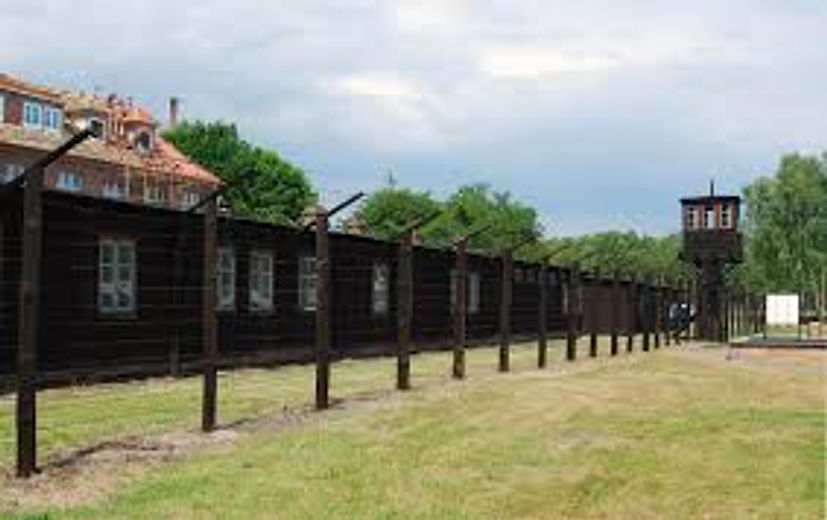
Explore Gdansk's legacy of war and peace during an orientation tour of the city, and a visit to the Stutthof Concentration Camp.
Depart the pier for the drive to the former Stutthof Concentration Camp. Upon arrival, you will take a guided tour of the camp. In mid-August 1939, the site for the future concentration camp was selected and on the first day that the Nazis invaded Poland, 1,500 arrests were made. In early-September 1939, 150 of those arrested were transported to Stutthof, thereby beginning the tragic story of this camp. Over the next few years, thousands of Poles were exterminated here. From 1940-1944, Stutthof grew from a small, 30-acre camp intended for 3,500 prisoners to a 300-acre camp holding 57,000 prisoners. By 1942, Poles were rounded up and transported from all over Europe. In June 1944, Stutthof became part of the Nazi's final solution to the Jewish problem and a camp of mass extermination. In all, Stutthof comprised 39 sub-camps, and 110,000 prisoners of all faiths and nationalities. Before Stutthof was finally liberated by Soviet troops on May 9, 1945, 65,000 prisoners were killed there.
Next, you will proceed to Gdansk's Old Town. The city's thousand-year history has left a collection of buildings and monuments designed in Gothic, Renaissance and Baroque architectural styles. Your tour begins near the Golden Gate, a grand ornamental arch that once permitted access through the Medieval city's defensive walls. You will then proceed along Long Street, which is lined with marvelous buildings adorned by elaborate facades and a myriad of ornate gables. You will continue on past the Long Market and beautiful 15th-century Merchants Palace of Artus Court to Neptune's Fountain. A brief stop will be made here to admire this symbol of Gdansk's Hanseatic past, and its connection with the sea. You will then stroll the waterfront and turn on St. Mary's Street, or Mariacka, which features a lively atmosphere, quaint shops and lovely terraced buildings.
Your tour concludes with a visit to the Gothic-style St. Mary's Church, the pride of Gdansk. St. Mary's is the world's largest brick church, and accommodates some 25,000 worshippers. Situated in the center of the Old Town, this Medieval church took 159 years to build. You will find its deceptively plain exterior belies a bright, spacious interior with large windows with more than 30 beautifully-decorated chapels. Inside the church, you will see the high altar displaying a lovely panel painting, and floor covered with ancient tombstones. The northern transept holds an amazing, 15th-century astronomical clock, complete with the zodiac cycle and a calendar of the saints.